
Article: Air Conditioner Without an Outdoor Unit: Heating and Cooling Guide for UK Homes
Air Conditioner Without an Outdoor Unit: Heating and Cooling Guide for UK Homes
As winter approaches in the UK, homeowners are increasingly looking for efficient ways to heat individual rooms without installing a completely new heating system. Modern air conditioners without an outdoor unit can provide both heating and cooling throughout the year, making them a practical solution for homes, flats, apartments, home offices and garden rooms.
Unlike a conventional electric heater, a heating-capable monobloc air conditioner works as an air-to-air heat pump. It uses electricity to transfer heat from the outdoor air into the room rather than simply converting electricity directly into heat.
Three well-known examples of this technology are Olimpia Splendid Unico, Powrmatic and Panasonic Solo.
What Is an Air Conditioner Without an Outdoor Unit?
A conventional split air conditioner consists of an indoor unit connected to an outdoor condenser. The compressor and other refrigeration components are normally located outside the building.
A monobloc system takes a different approach. The main refrigeration components are contained within a single indoor appliance, which is why it is often described as an air conditioner without outdoor unit, AC without outdoor unit or self-contained AC.
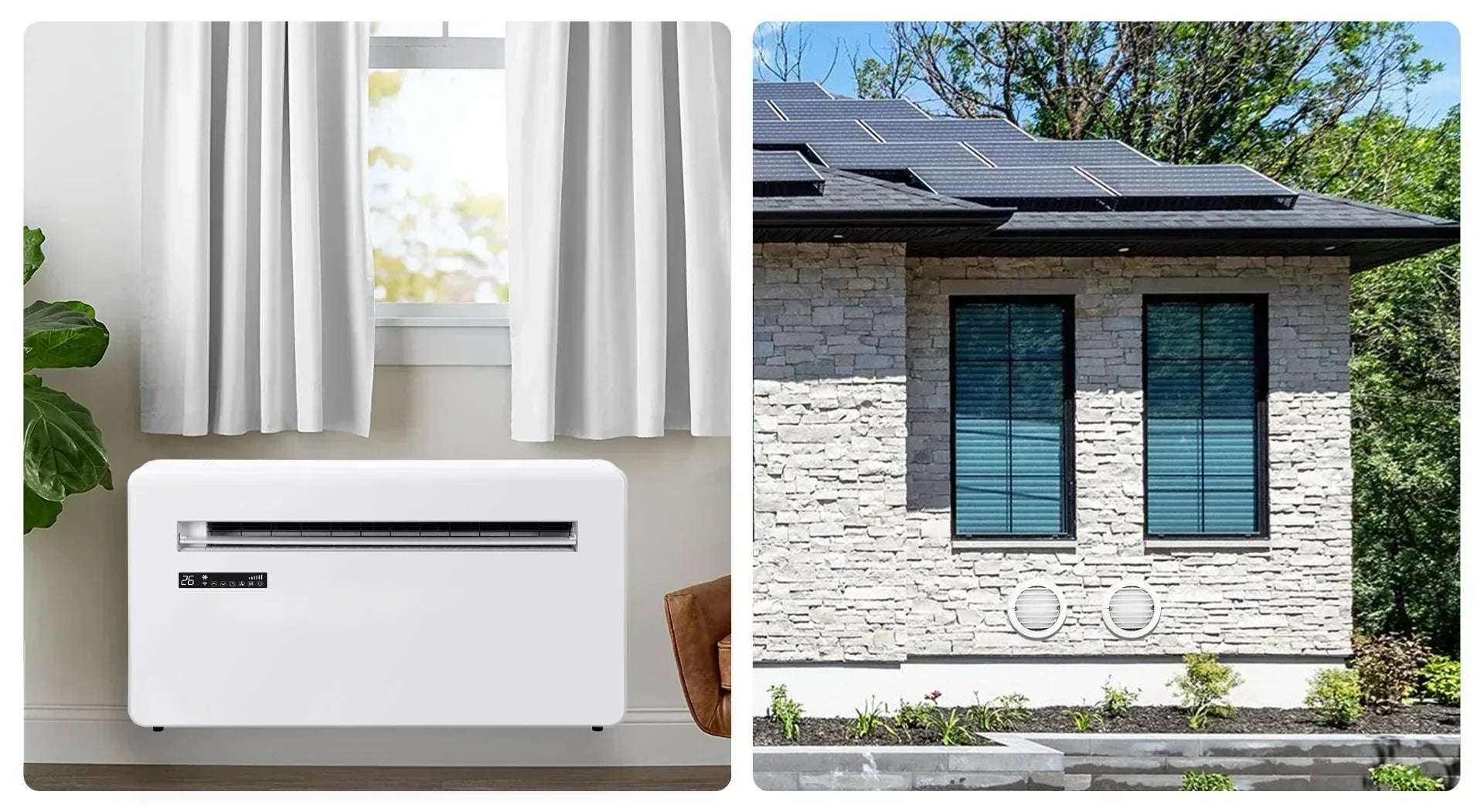
A fixed system still needs to exchange air with the outside. This is normally achieved through specially designed openings in an external wall.
Therefore, an air conditioner no outdoor unit does not mean that the appliance has no connection with the outside. It means that there is no conventional external condenser mounted separately on the building.
This concept is used by Olimpia Splendid Unico, while Panasonic Solo is another example of an indoor monobloc approach.
How Does a Monobloc Air Conditioner Heat a Room?
In cooling mode, the system removes heat from the room and transfers it outside.
In heating mode, the refrigeration cycle reverses. The system extracts thermal energy from outdoor air and transfers it indoors.
This makes a heating-capable heat pump air conditioner without outdoor unit fundamentally different from a standard electric heater.
An electric heater converts electricity directly into heat. A heat pump uses electricity to move thermal energy that already exists in the environment.
This is the main reason why an energy efficient air conditioner without outdoor unit can potentially provide considerably more useful heat than the amount of electricity it consumes.
How Much Heat Can 1 kWh of Electricity Produce?
One of the most important things to understand when considering a heat pump for winter heating is the COP, or Coefficient of Performance.
With direct electric heating:
1 kWh of electricity ≈ 1 kWh of heat.
If a heat pump operates at COP 2:
1 kWh of electricity ≈ 2 kWh of heat.
At COP 3:
1 kWh ≈ 3 kWh of heat.
At COP 4:
1 kWh ≈ 4 kWh of heat.
At COP 5:
1 kWh ≈ 5 kWh of heat.
These figures illustrate the principle rather than guaranteeing a particular performance level.
COP changes according to outdoor temperature, indoor temperature, heating demand and operating conditions.
Nevertheless, the difference between direct electric heating and heat-pump technology is significant. The heat pump is not simply creating all the heat from electricity; it is transferring thermal energy from outside.
COP and SCOP: Why Are They Important for Winter Heating?
COP describes efficiency under particular operating conditions.
For homeowners in the UK, SCOP, or Seasonal Coefficient of Performance, is also particularly useful because winter temperatures vary considerably.
A heat pump may operate with a high COP during relatively mild weather but become less efficient as outdoor temperatures fall.
For example, a theoretical SCOP of 4 means that over the relevant seasonal calculation, the system delivers approximately four units of heating energy for every unit of electricity consumed.
It does not mean that the system will operate at COP 4 continuously throughout the winter.
When choosing Olimpia Splendid Unico, Panasonic Solo or another monobloc system for heating, it is therefore worth looking at heating capacity, low-temperature performance, COP and SCOP rather than focusing only on cooling capacity.
How Much Does Heat Pump Heating Cost?
COP can also help illustrate the potential running-cost advantage.
Suppose electricity costs 25p per kWh.
With direct electric heating, producing approximately 1 kWh of useful heat would cost around 25p.
With a heat pump operating at COP 2, the theoretical cost of 1 kWh of useful heat would be around 12.5p.
At COP 3, it would be approximately 8.3p.
At COP 4, approximately 6.25p.
At COP 5, approximately 5p.
The basic calculation is:
Electricity price ÷ COP = approximate cost of useful heat.
For example:
25p ÷ 4 = 6.25p per kWh of useful heat.
These are illustrative calculations rather than guaranteed household running costs. Actual performance changes with outdoor temperature, room temperature, insulation, system sizing, operating hours and electricity tariffs.
The calculation nevertheless demonstrates why heat-pump heating can be considerably more efficient than direct electric heating.
Can an Air Conditioner Heat Below 0°C?
Yes. Modern heat pumps can operate in sub-zero temperatures because cold outdoor air still contains thermal energy.
However, efficiency normally decreases as outdoor temperatures fall, and available heating capacity can also change.
This is why low-temperature performance is particularly important when choosing an air conditioner without an outdoor unit for winter heating.
It is worth checking the manufacturer's specifications for minimum operating temperature and heating output at lower temperatures.
During cold and humid weather, frost can also form on the heat exchanger. The system can automatically enter a defrost cycle to remove it.
This is a normal part of heat-pump operation.
Air Conditioner Without Outdoor Unit Installation
One of the main attractions of monobloc technology is that there is no conventional outdoor condenser.
The main appliance is installed inside the property, normally on an external wall. Installation typically requires two wall openings of either 162 mm or 202 mm in diameter, depending on the model, plus one separate drainage opening for condensate. The exact requirements should always be checked for the specific unit.
An air conditioner without outdoor unit installation can therefore be useful where an external unit is difficult, undesirable or restricted.
The main appliance is installed inside the property, normally on an external wall.
However, installation still requires careful planning.
The installer needs to consider the wall structure, position of the openings, airflow, drainage, electrical supply, vibration, noise and future maintenance access.
A fixed monobloc should not be confused with a portable air conditioner using a flexible exhaust hose.
Wall-Mounted Air Conditioner Without External Unit
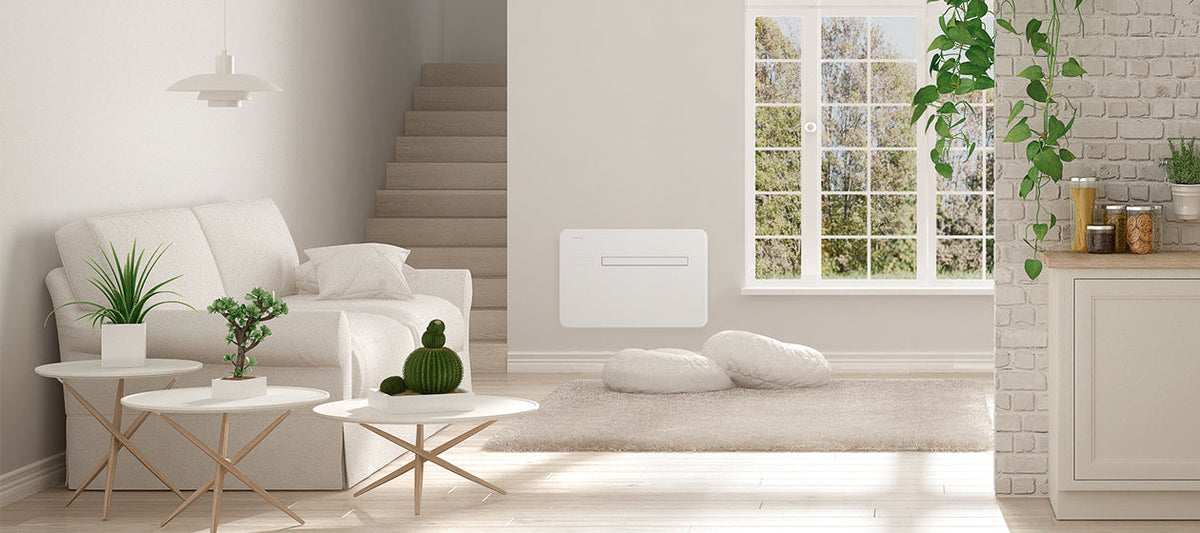
A wall-mounted air conditioner without external unit can be particularly useful where floor space is limited.
Instead of having a portable appliance standing on the floor, the system becomes a permanent part of the room.
This makes the format suitable for bedrooms, living rooms, home offices, apartments and garden rooms.
Olimpia Splendid Unico is particularly associated with this type of wall-mounted monobloc installation.
Panasonic Solo also offers an indoor approach for applications where a conventional outdoor condenser is not preferred.
The precise installation requirements and performance depend on the individual model.
Air Conditioner Without Ductwork
A monobloc system does not require the extensive duct network used by some central HVAC systems.
An air conditioner without ductwork can provide heating and cooling directly to the room where it is installed.
This can be useful in existing properties, extensions, individual bedrooms, home offices and older houses where installing ductwork would be disruptive.
However, the absence of ductwork does not mean that there is no connection to outside air. Fixed monobloc systems still require appropriately designed wall openings.
Quiet and Silent Air Conditioner Without Outdoor Unit
Noise is an important consideration when installing an air conditioner in a bedroom or home office.
This is why homeowners often look for a silent air conditioner without outdoor unit or a quiet AC no outdoor solution.
Modern inverter systems can reduce their output once the desired temperature has been reached. This can allow the system to operate at a lower level rather than continuously running at maximum capacity.
Actual noise levels depend on the model, fan speed, compressor operation, wall construction and installation quality.
For bedrooms, it is sensible to check the manufacturer's noise figures at lower fan speeds as well as the maximum rating.
Air Conditioning for Historic and Heritage Buildings
Monobloc technology can be particularly interesting for older properties in the UK.
Owners of period homes may want modern heating and cooling without installing a large external condenser on the façade.
This makes an air conditioner for a historic building a potentially useful option where the visual impact of conventional external equipment is a concern.
The same applies to air conditioning for heritage buildings, where preserving the appearance of the property may be an important consideration.
A reversible monobloc can also provide climate control for historic buildings, combining heating in winter with cooling during warmer weather.
For listed properties, however, additional restrictions may apply.
Air Conditioning for Listed Buildings
Installing air conditioning for listed buildings requires particular care.
A monobloc system can avoid the need for a conventional outdoor condenser, but external wall openings may still represent a change to the building.
Depending on the property, planning permission, listed building consent, freeholder approval or other permissions may be required.
A professional assessment should therefore be carried out before installation.
For heritage and period properties, the technical requirements of the air conditioner need to be considered alongside the architectural requirements of the building.
Heating Flats, Apartments, Home Offices and Garden Rooms
One of the strongest applications for an air conditioner no outdoor unit is heating and cooling an individual room.
A home office may only need heating during working hours. A bedroom may require a different temperature from the rest of the house. A garden room may need both heating in winter and cooling in summer.
A dedicated indoor heat pump allows these spaces to be controlled independently.
This can be particularly attractive in properties where installing a conventional split air conditioner with an external unit is difficult.
Can One Monobloc Unit Heat an Entire House?
Usually, one unit is designed for one room or an open-plan area.
An indoor-only air conditioner cannot automatically distribute heat evenly through several closed rooms or multiple floors.
Larger properties may therefore require more than one unit.
The correct number depends on room size, insulation, windows, external walls, ceiling height and heat loss.
This is why choosing an air conditioner simply according to floor area is not always sufficient.
For winter heating, it is especially important to consider the heating output available at lower outdoor temperatures.
Olimpia Splendid Unico
Olimpia Splendid Unico is one of the best-known names in fixed monobloc air conditioning.
Its design places the principal refrigeration components inside the wall-mounted appliance, eliminating the need for a conventional external condenser.
Heating-capable models can operate as air-to-air heat pumps, providing heating during colder months as well as cooling in summer.
This makes Olimpia Splendid Unico relevant for homes looking for an indoor air conditioner, a wall mounted air conditioner without external unit, or a modern heating and cooling system without a conventional outdoor unit.
Different Unico models have different capacities and specifications, so the correct model should be selected according to the room's heat loss, required output and installation conditions.
Panasonic Solo
Panasonic Solo is another example of the indoor monobloc approach.
The system is designed for applications where heating and cooling are required without the conventional outdoor condenser arrangement of a split system.
Heating-capable models can operate as heat pumps during winter and provide cooling during warmer weather.
This makes Panasonic Solo an option for homeowners looking for an indoor air conditioner that does not require a traditional external condenser.
As with any heating system, the exact model should be assessed according to its heating capacity, low-temperature performance, COP, SCOP, sound level and installation requirements.
What Should You Check Before Buying?
If winter heating is the main objective, do not choose a monobloc air conditioner based only on its cooling capacity.
The most important factors include heating capacity, performance at low outdoor temperatures, COP and SCOP, operating temperature range, noise level, room heat loss, insulation and installation requirements.
A well-insulated 25 m² room can have completely different heating requirements from a poorly insulated 25 m² room with several external walls and large windows.
Correct sizing is therefore essential.
An oversized system may cycle unnecessarily, while an undersized system may have difficulty maintaining the required temperature during colder weather.
Final Verdict: Is a Monobloc Air Conditioner Good for Winter Heating?
A modern air conditioner without an outdoor unit can be a highly practical heating solution when it is correctly selected and installed.
Its biggest advantage is the use of heat-pump technology. Instead of turning every kilowatt-hour of electricity directly into one kilowatt-hour of heat, the system transfers thermal energy from the outdoor air.
Under suitable conditions, 1 kWh of electricity can therefore provide several kWh of useful heat. The actual result depends on the COP, outdoor temperature and operating conditions, while SCOP provides a broader indication of seasonal efficiency.
This makes a reversible monobloc particularly interesting as winter approaches, especially for homeowners currently using direct electric heaters or looking for efficient heating for a specific room.
At the same time, the system provides cooling during summer, so the investment can deliver useful climate control throughout the year rather than being used only during the heating season.
Olimpia Splendid Unico and Panasonic Solo are two established examples of the monobloc concept. They can be considered for flats, apartments, bedrooms, home offices, garden rooms and certain period, historic and heritage properties where a conventional outdoor condenser may not be appropriate.
The most important factor is not simply the brand. A successful installation depends on choosing the correct capacity, checking low-temperature heating performance, understanding COP and SCOP, considering noise and insulation, and ensuring that the installation is suitable for the building.
For anyone searching for an air conditioner without an outdoor unit, an energy efficient air conditioner without outdoor unit, a heat pump air conditioner without outdoor unit or a wall-mounted air conditioner without external unit, modern monobloc technology offers a practical way to combine efficient winter heating with summer cooling.
And with winter approaching, now is a good time to assess the heat loss of the room, check the available heating capacity and plan installation before the coldest part of the season arrives.
A properly sized and professionally installed monobloc heat pump can provide comfortable heating when it is needed, efficient cooling in summer and a discreet alternative to a conventional split air-conditioning system — all from a single indoor unit.